Two pumps, two jobs
| Pump | What it does | When you need it |
|---|---|---|
| Recirculation pump | Moves hot water through the loop so it is ready at the tap | Long waits for hot water |
| Descaling flush pump | Circulates a cleaning solution through the heat exchanger | Annual or periodic maintenance |
| Booster pump | Raises water pressure | Low flow rate through the heater |
A tankless heater does not store hot water, so it makes it on demand. That is efficient, but there is a delay while the water travels from the heater to the faucet. That delay is what a recirculation pump addresses.
Recirculation pumps
A recirculation system keeps a small flow moving between the heater and the fixtures, so hot water is near the tap. Some heaters have a built-in pump or a buffer tank. Others use an add-on pump with a return line or a crossover valve under the farthest sink.
- Dedicated return line systems are the most efficient, but need a pipe back to the heater.
- Crossover valve systems use the cold line as the return, and they warm that line a little.
- Timers and temperature controls reduce running time and wasted energy.
A recirculation pump costs money to run and loses some heat through the pipes. It is worth it when waiting for hot water is a daily annoyance, less so if it is a small house with the heater near the taps.
The flush pump and descaling
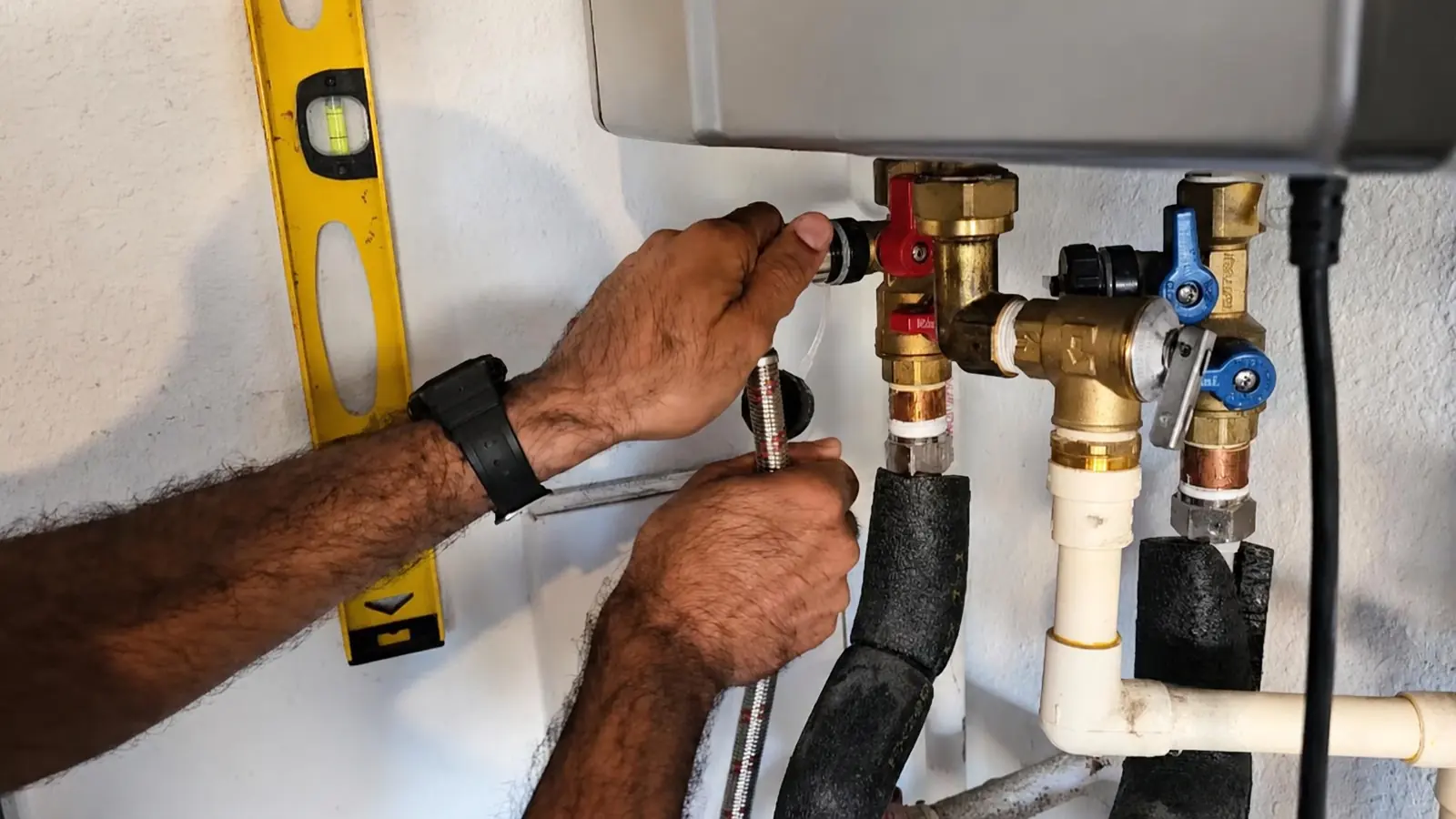
Minerals in water leave scale inside the heat exchanger of a tankless heater, and scale lowers flow and efficiency. Flushing circulates a mild acid solution, often food-grade vinegar or a descaling product, through the unit using a small pump and two hoses connected to isolation valves.
- Turn off the gas or power to the heater and close the water supply valves.
- Connect the pump and hoses to the service ports on the isolation valves.
- Run the solution through the unit for the time the manufacturer recommends.
- Flush with clean water, remove the hoses, open the valves and restore power.
Follow your heater's manual. Some manufacturers set the flush interval based on water hardness. Our tankless water heater page covers flushing and repair, and the water heater repair page covers error codes and failures.
Cost of running a recirculation pump
A pump uses a small amount of electricity, but the real cost is heat loss. Hot water circulating through pipes gives up warmth to the house, and the heater has to make it up. A timer or a temperature sensor reduces that waste. Running the pump only in the morning and evening is a common setup.
The benefit is less water down the drain while you wait for it to warm up. In a house with a long pipe run to a bathroom, that can mean minutes of running cold water each time. If you wait only a few seconds today, a pump will not change your life.
Ask your installer to explain the choices on the table: a dedicated return line, a crossover valve, a built-in pump or a buffer tank. Each one fits different houses, and the right one depends on how your pipes are laid out.
Common mistakes with tankless pumps
- Buying a recirculation pump the heater manufacturer does not approve.
- Running the pump around the clock with no timer.
- Skipping the isolation valves that make flushing possible.
- Using a harsh cleaner that the manual does not allow.
Most of these are avoidable by reading the manual and asking the installer which parts they are using. If you already have a heater with no service valves, adding them is a small job that makes every future flush faster and cleaner.
A pump that is installed but never maintained is also a problem. Check it once a year for noise, leaks and heat, and replace it if it runs hot or grinds.
Tankless Heater Trouble?
Tell us the model and what the display shows. Our 24/7 line is open now.
Water quality and your local utility
Aqua Pennsylvania has been replacing aging water mains in Upper Darby, including a project on Township Line Road. The utility publishes annual water quality reports, and you can ask it about hardness for your area. We do not state a hardness number for Upper Darby, because it varies by system and by year.
A simple hardness test strip at your tap gives a quick answer. Hard water means more scale and more frequent flushing.
Choosing and installing a pump
Match the pump to the heater. Some manufacturers warn that an unapproved add-on can void a warranty. Check the manual and ask before you buy. Installation involves pipe changes, power for the pump and sometimes a new valve, so the work overlaps with water heater installation.
We serve Lansdowne and Haverford Township near Upper Darby, and you can read about them on our Lansdowne plumber and Haverford Township plumber pages.
Signs your tankless heater needs attention
- Water that turns lukewarm or fluctuates in temperature.
- Error codes on the display.
- Noises like popping or rumbling from the unit.
- Lower flow even when water pressure elsewhere is fine.
Sources: the heater manufacturer's guidelines decide which pumps are approved and how often to flush, and Aqua Pennsylvania publishes annual water quality reports.
Questions Upper Darby homeowners ask
No. It helps when hot water takes a long time to reach the faucet. Small homes with the heater close to the fixtures may not need one.
It depends on the manufacturer and the hardness of your water. Check the manual, and test your tap or ask your water utility about hardness.
We do not give a number because it varies by system. Test your tap with a strip or ask your water utility for its water quality report.