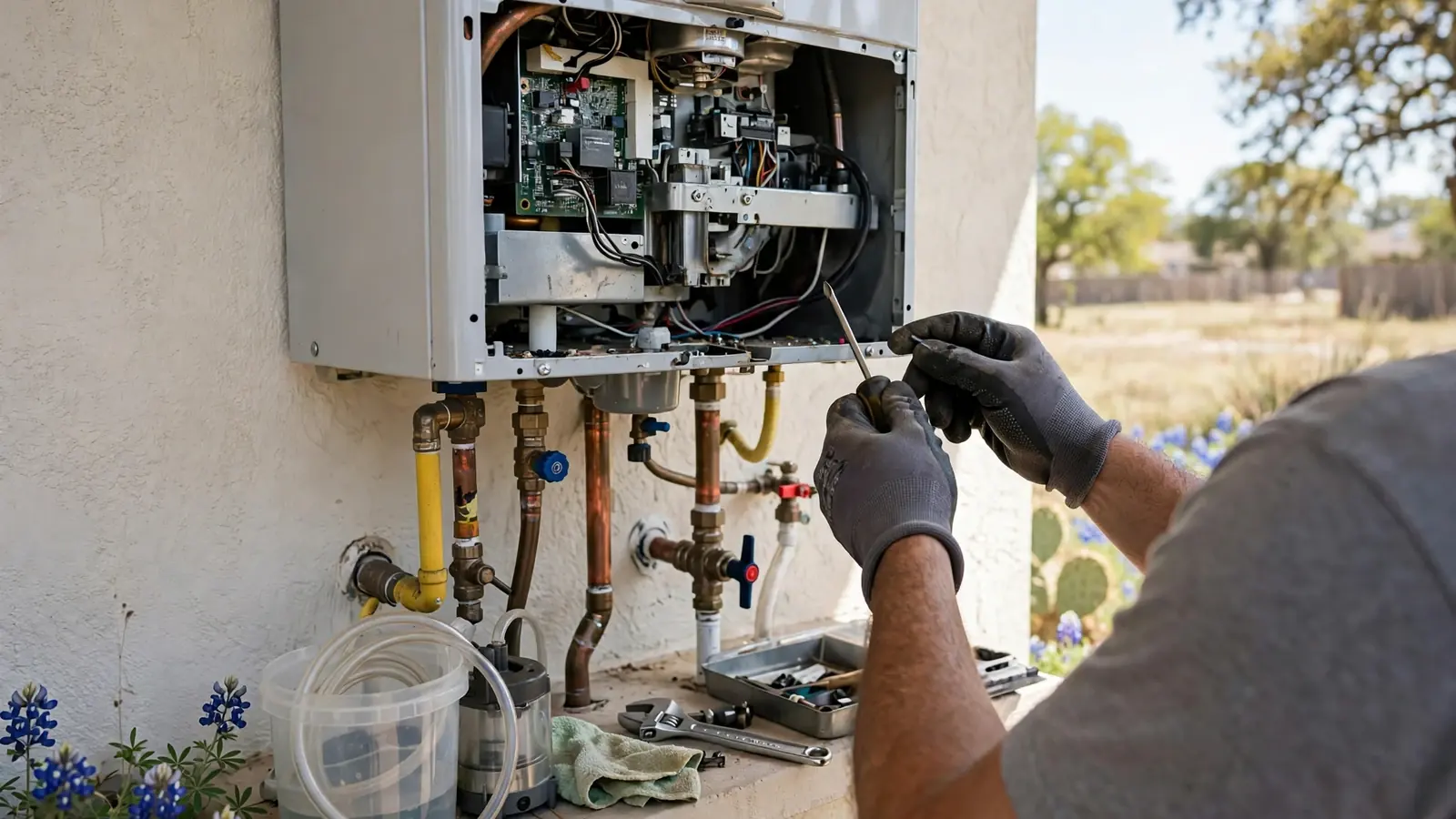
What a tankless conversion changes in the house
A tankless gas unit demands a lot of gas at once, often more than the old tank burner did. The existing gas line may be too small, and the vent is almost always different, using stainless or plastic venting through a wall. We measure both before quoting, because they decide whether the job is simple or large.
The water side matters as well. Tankless units need a certain flow to fire, so very low flow fixtures can cause a cold sandwich effect. We explain that with your actual fixtures in mind.
Installing a tankless unit outside
Outdoor tankless units are rated for exterior mounting and free up basement space. They need freeze protection for the water lines and the unit in cold weather, and a protected location away from windows and air intakes. In Pennsylvania winters, an outdoor install without freeze protection is a risk we do not take, and we tell you when a basement or indoor wall is the safer location.
Flushing and descaling, the maintenance that matters
Scale builds up inside the heat exchanger when hard water is heated. It narrows the passages and the unit starts showing error codes, short cycling or low flow. A flush with a descaling solution and a pump removes it. Most manufacturers call for periodic flushing, and the interval depends on your water and how much you use.
We do not state a hardness figure for Upper Darby, because it varies by system and by year. Test your tap with a hardness strip or ask your water utility for its annual water quality report, and we will set the flush interval from what you find.
| Service | What it fixes | When to call |
|---|---|---|
| Flush and descale | Scale in the heat exchanger | Error codes, low flow, yearly maintenance |
| Inlet screen cleaning | Debris blocking flow | Sudden drop in output |
| Circulation pump install | Long wait for hot water | Cold delay at distant fixtures |
| Venting repair | Flue or condensate problems | Fault codes about exhaust or condensate |
| Replace the unit | Failed heat exchanger or board | Repair cost near new-unit cost |
Tankless unit throwing an error?
Call and give us the code on the display. Many faults are diagnosed by phone before a truck rolls.
A water pump for a tankless water heater
A recirculation pump keeps a loop of hot water moving so you do not wait for it at a far bathroom. On a tankless system it is installed with a return line or a crossover valve and a timer or sensor. It costs less to run than leaving a tank hot all day, but it adds a part that needs maintenance, and we explain the trade-off.
Repair or replace a tankless unit
Fault codes often point to simple items: a clogged inlet screen, a blocked condensate line, or scale. When the heat exchanger itself has failed or a control board is out of parts, replacement is the honest answer. If your tank-style unit is the problem, read about water heater repair instead.
Sizing a tankless unit by demand
A tank is sized by gallons. A tankless unit is sized by flow, the number of gallons per minute you need at a given temperature rise. A house with two showers, a dishwasher and a washer running together needs more flow than one with a single bathroom. The incoming water temperature in winter also matters, because colder water takes more heat to raise.
| Question | Why it matters |
|---|---|
| How many fixtures run at once? | Sets the flow rate you need |
| How cold is the winter supply? | Sets how much heat the unit must add |
| Is the gas line large enough? | A tankless burner draws far more gas than a tank |
| Where will it vent? | Exhaust has to leave the house safely |
We work through those four questions before quoting a unit, and we are honest when a tank is the better fit. Some older houses make a tankless conversion expensive because of the gas line and the vent. For a planned conversion, see water heater installation.
What tankless service costs
We quote after we see the unit, since a flush and a conversion are very different jobs.
Insurance seldom covers tankless maintenance or conversions. Want your real number? Call (215) 714-6692.
Sources: your heater's manual sets the flush interval and venting rules, and the township applies the Pennsylvania Uniform Construction Code (34 Pa. Code § 403.21, which brings in the International Plumbing Code, IPC) to installs. A contractor can be looked up at hicsearch.attorneygeneral.gov.
Questions homeowners ask
Yes, with freeze protection and a safe location. In cold weather an indoor wall is often the better choice, and we tell you that when we see the site.
It depends on the manufacturer and on how hard your water is. Test your tap or ask your utility for its water quality report, and we will set the interval from that.
Common causes are scale, a blocked inlet screen, a condensate problem or a venting fault. Tell us the code and the make and we can narrow it down by phone.
Yes. The 24/7 line takes tankless calls, though a planned flush or conversion is scheduled for a regular visit.