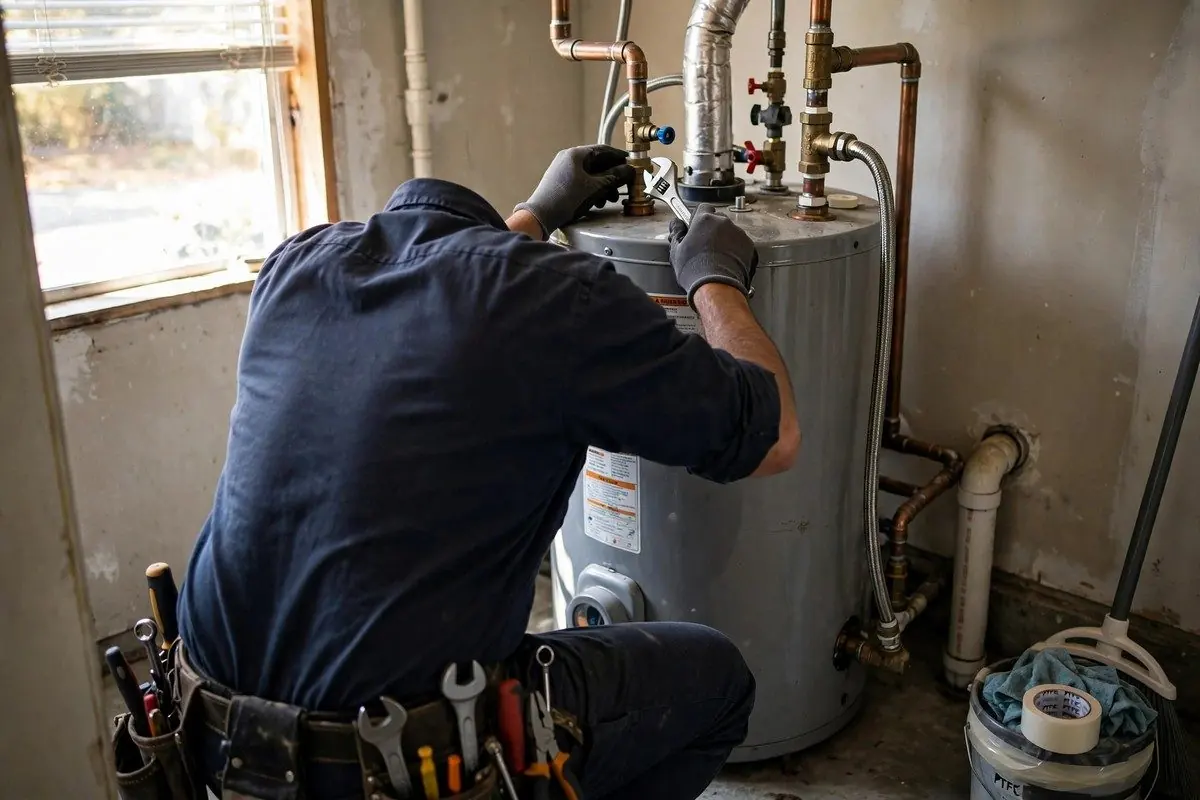
Leak at the tank or no hot water: which one is yours
The two problems need opposite reactions. A tank that leaks from its body is usually finished, because the steel liner has corroded through and no repair seals it. A tank that stays cold, runs out fast or smells odd is more often a failed part, and parts can be replaced.
We ask three questions on the phone: where the water is, whether the unit is gas or electric, and how old the tank is. That sorts most calls before a truck rolls, and if the tank has failed we say so honestly and point you toward water heater replacement instead of selling a repair that will not hold.
What fails on a gas water heater
- The thermocouple or flame sensor stops sensing the pilot, so the burner shuts off.
- The gas control valve fails and will not open or will not hold temperature.
- Sediment at the bottom of the tank insulates the burner from the water and causes popping noises.
- Flue draft problems cause the pilot to blow out or the unit to short cycle.
If you smell gas, do not light anything or flip switches. Leave the house and call the gas utility or 911 first, then call us. A pilot that will not stay lit is a repair job. A smell of gas is a safety call.
What fails on an electric water heater
Electric tanks have two heating elements and two thermostats. When the upper element burns out, you may get a short supply of hot water. When the lower one fails, the tank heats only the top third and runs out quickly. A tripped high-limit reset or a failed thermostat can take out both.
We test elements with a meter before replacing them. Replacing an element is a fraction of the cost of a new tank, so we check that the tank itself is sound before spending money on the cheap part. A tank that is leaking at the element gasket is a different, smaller repair.
| Symptom | Common cause | Repair or replace? |
|---|---|---|
| Water leaking from tank body | Corroded liner | Replace |
| Drip at the temperature and pressure valve | Valve or expansion pressure issue | Usually repair |
| No hot water, electric | Element, thermostat or high-limit | Usually repair |
| No hot water, gas | Pilot, thermocouple or gas control | Usually repair |
| Rumbling or popping | Sediment buildup | Flush or repair, replace if old |
| Rusty hot water only | Anode rod spent or tank corroding | Depends on age |
No hot water tonight?
Call the 24/7 line. A same-day appointment is often possible for water heater calls.
Tankless units and hybrid heaters
Tankless heaters, electric and gas hybrid designs and heat pump water heaters fail in different ways than a simple tank. Error codes, scale buildup and flow sensor faults are the usual suspects. We run diagnostics on the unit rather than guessing, and if a flush or descale is all it needs, our tankless water heater service page explains what that involves.
Water heater problems in older Upper Darby homes
Basements in older twins and rowhouses often hold a water heater that has been in place for a decade or more, sometimes in a tight utility corner with limited flue clearance. Tanks that old are prime candidates for liner failure, and a repair bill on a tank near the end of its life is money that could go toward a new one.
We tell you the manufacture date from the data plate, explain what it means, and let you choose. On properties near Terminal Square and along Garrett Road we also handle small commercial units, and the commercial plumbing page covers that work.
Reading the symptoms before we open anything
| What you notice | Most likely cause | Repairable? |
|---|---|---|
| Lukewarm water only | Failed lower element or sediment on the burner | Usually yes |
| No hot water at all, gas unit | Pilot, thermocouple or gas valve | Usually yes |
| No hot water at all, electric unit | Tripped breaker, upper element or thermostat | Usually yes |
| Water pooling under the tank | Fitting, relief valve or a failed tank | Only if it is not the tank |
| Rusty hot water only | Corroded tank or a spent anode rod | Depends on the tank age |
| Rumbling or popping | Sediment on the bottom of the tank | Flushing often helps |
The first question we ask is whether water is coming from the tank itself or from something attached to it. A drip from a supply connection, a drain valve or the relief valve can be fixed in a short visit. A leak through the steel shell cannot, and we say so plainly instead of selling a repair that will not hold.
What to check before you call
- On an electric heater, look for a tripped breaker and a reset button on the upper thermostat cover.
- On a gas heater, look at the pilot or the display and confirm that the gas valve is open.
- Feel the pipes around the tank. If the cold inlet is warm, a valve may be failing.
- Look for water on the floor and note where it appears first.
- Write down any error code or blinking pattern from the control.
If you smell gas at any point, leave the house and call the gas utility or 911 first. Gas safety work comes before any repair, and we come after the house is cleared.
When repair makes sense and when it does not
A heater that is under a decade old with a bad element, thermostat or valve is usually worth repairing. A tank in its second decade that needs several parts is a different calculation, because a repair does not reset the age of the steel. Sediment and corrosion keep working even when a new part works perfectly.
We give you both numbers when it is close: what the repair costs and what replacement costs. If the repair is sound, we do it. If it is not, we explain why, and our water heater replacement page describes what a swap involves, including what to expect from the old unit's removal.
Maintenance that keeps a repaired heater running
- Flush a few buckets of water from the drain valve once a year to move sediment out.
- Test the relief valve by lifting its lever briefly, with a drain pipe attached.
- Check the anode rod every few years once the tank is aging.
- Keep the area around a gas heater clear of storage so air can reach the burner.
We also recommend a drain pan and a water alarm in a finished basement. A small leak caught early is a repair. A slow leak found by a stained ceiling is a larger bill, and it is the kind of damage that insurance often declines to cover.
What water heater repair costs
We give you the price before any parts are ordered or installed.
Water heater failures from slow leaks are often excluded by homeowners insurance, while a sudden burst may be covered. Check with your carrier. Want your real number? Call (215) 714-6692.
Sources: the township has adopted the Pennsylvania Uniform Construction Code (34 Pa. Code § 403.21, which brings in the International Plumbing Code, IPC) and asks for permits on some residential repairs, so ask the Department of Licenses and Inspection what applies. Gas problems go to the gas utility or 911 first.
Questions homeowners ask
Yes. We answer 24/7. A leaking tank is the most urgent version of this call, and we will tell you how to shut off the supply and power while the plumber is on the way.
Look at the data plate for the manufacture date and ask whether the tank itself is leaking. A sound tank with a failed part is worth repairing. A leaking tank, or a unit well past a decade old with repeated problems, usually is not.
On an electric tank, a failed lower element is a frequent cause. On a gas tank, heavy sediment can reduce usable capacity. A heater that is too small for the household can also behave this way.
Yes, for many faults. We read the error code, check the flow sensor and inlet screen, and tell you whether a descale will fix it. Parts availability varies by brand.