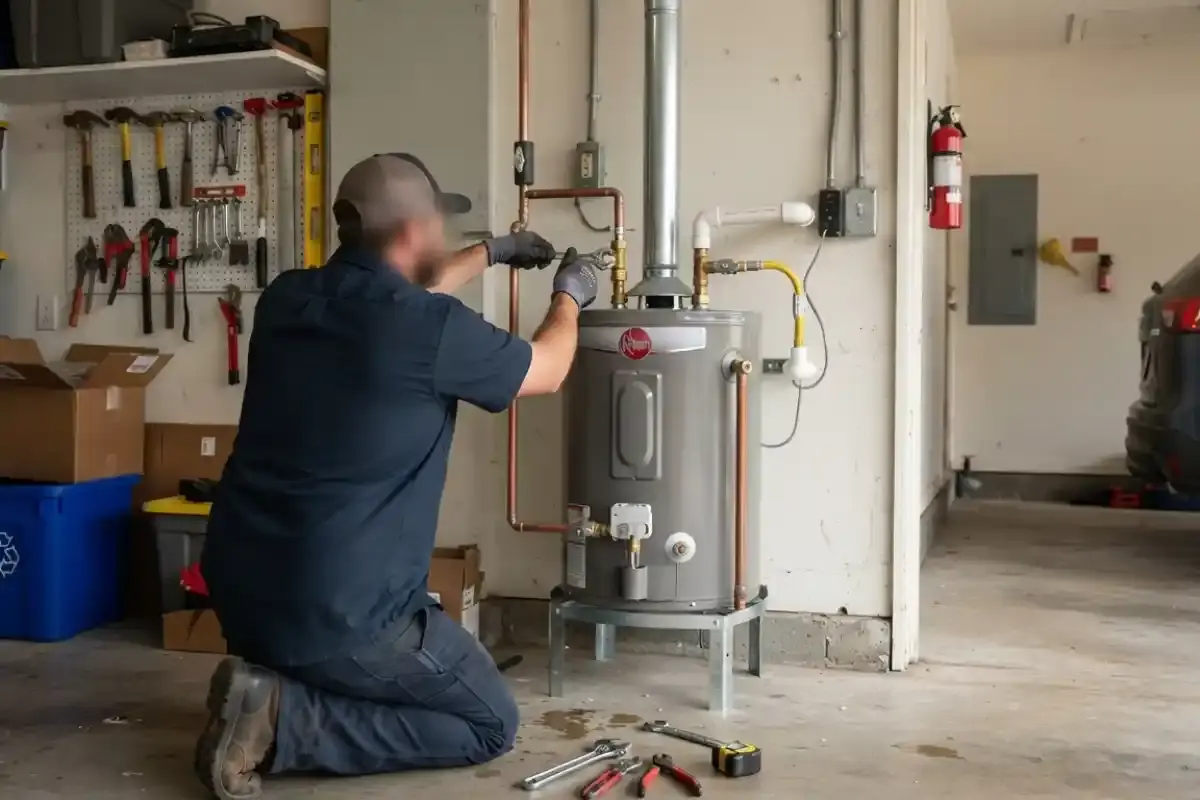
Installing a 50 gallon gas water heater
A 50 gallon gas tank is the common upgrade for a family that has outgrown 40 gallons. The unit is taller or wider than the old one, so we measure the space, the flue path and the clearance to combustibles before ordering. A standard 50 gallon gas tank needs a gas connection, a vent to a chimney or a direct vent, and combustion air.
If the old tank vented into a masonry chimney, the liner size and condition matter. A newer, more efficient unit can produce flue gases too cool for an old chimney, which can lead to condensation damage. We check this and tell you if a liner or a different venting approach is needed.
Planned installs worth doing before a failure
Upgrade for a growing household
More people means more morning demand, and a larger tank or a faster recovery unit solves it.
Move the unit
Relocating from a cramped corner to an open wall improves service access and venting.
Switch fuel
Going from electric to gas, or the reverse, changes pipe, circuit and venting.
Replace before the leak
Swapping an old tank on your schedule avoids a flooded basement and an after-hours price.
Expansion tanks, valves and the parts people skip
A water heater heats water, and heated water expands. On a closed plumbing system with a check valve or pressure reducing valve at the meter, that expansion has nowhere to go and raises pressure in the house. An expansion tank gives it room. We check for a closed system and quote the tank where it applies.
We also install a new temperature and pressure relief valve with a discharge line that ends where it should, replace brittle supply connectors, and install new shutoff valves where the old ones will not turn. These are small items that prevent leaks and are listed on your quote, not discovered after the work starts.
Ready to schedule an install?
Call and tell us the current tank size, the fuel and where it sits. We will book an appointment, often the same day when available.
Gas safety on every install
We test every gas connection for leaks and confirm the flue draws before we leave. If you ever smell gas, leave the building and call the gas utility or 911 first. We do not promise a response time for a gas smell, because the right call comes first.
Choosing between a tank and a tankless unit
Traditional tank
- Lower upfront cost
- Simpler installation
- Limited supply per hour
- A basement floor space need
Tankless
- Hot water as long as the burner runs
- Wall-mounted, saves floor space
- Higher upfront and venting cost
- Needs yearly flushing
If you are leaning toward a tankless unit, read the tankless water heater page for what the conversion involves, including gas line size and flush schedules.
What a complete installation scope should list
- The model, size and fuel type of the unit.
- Removal and disposal of the old tank.
- New flexible connectors, shutoff valves and a relief valve with a discharge pipe.
- Venting changes for gas units, and the gas connection test.
- An expansion tank, if the house needs one.
- Permit coordination through the licensed master plumber.
If any of those is missing from a quote you receive, ask why. A low price that leaves out the vent work or the expansion tank is not a low price once the job is done. We list every part in the scope so you can compare apples to apples, and we say what is not included.
Timing and what you will notice on install day
A straightforward swap often takes a few hours. You will be without hot water for part of that time, and the gas or power will be off to the unit. We ask that the area around the heater be clear, and that someone be home to approve the work. When we finish, we light and test the unit, show you the shutoffs and explain the temperature setting. For a failed unit, see water heater replacement.
What drives water heater installation pricing
A written price comes before any work, based on what your house needs.
Insurance does not usually pay for planned upgrades. Want your real number? Call (215) 714-6692.
If an old tank is already leaking, skip ahead to water heater replacement, which is built for urgent swaps.
Sources: the Pennsylvania Uniform Construction Code (34 Pa. Code § 403.21, which brings in the International Plumbing Code, IPC), adopted by Upper Darby Township, governs new installs, and Upper Darby Township Code Chapter 265 requires a licensed master plumber behind any plumbing contractor. Follow the manufacturer's installation instructions for your model.
Questions homeowners ask
A swap in the same spot with compatible venting takes a few hours. A new flue, a relocation or new gas piping adds time.
If your system is closed, with a check valve or pressure reducing valve at the meter, usually yes. We check and explain before quoting.
Often yes. We look at the gas or electric run, the water lines and the vent path and tell you the real scope.
Permit rules vary, so ask the Upper Darby Department of Licenses and Inspection about the current requirement. We can tell you what our installs usually involve.