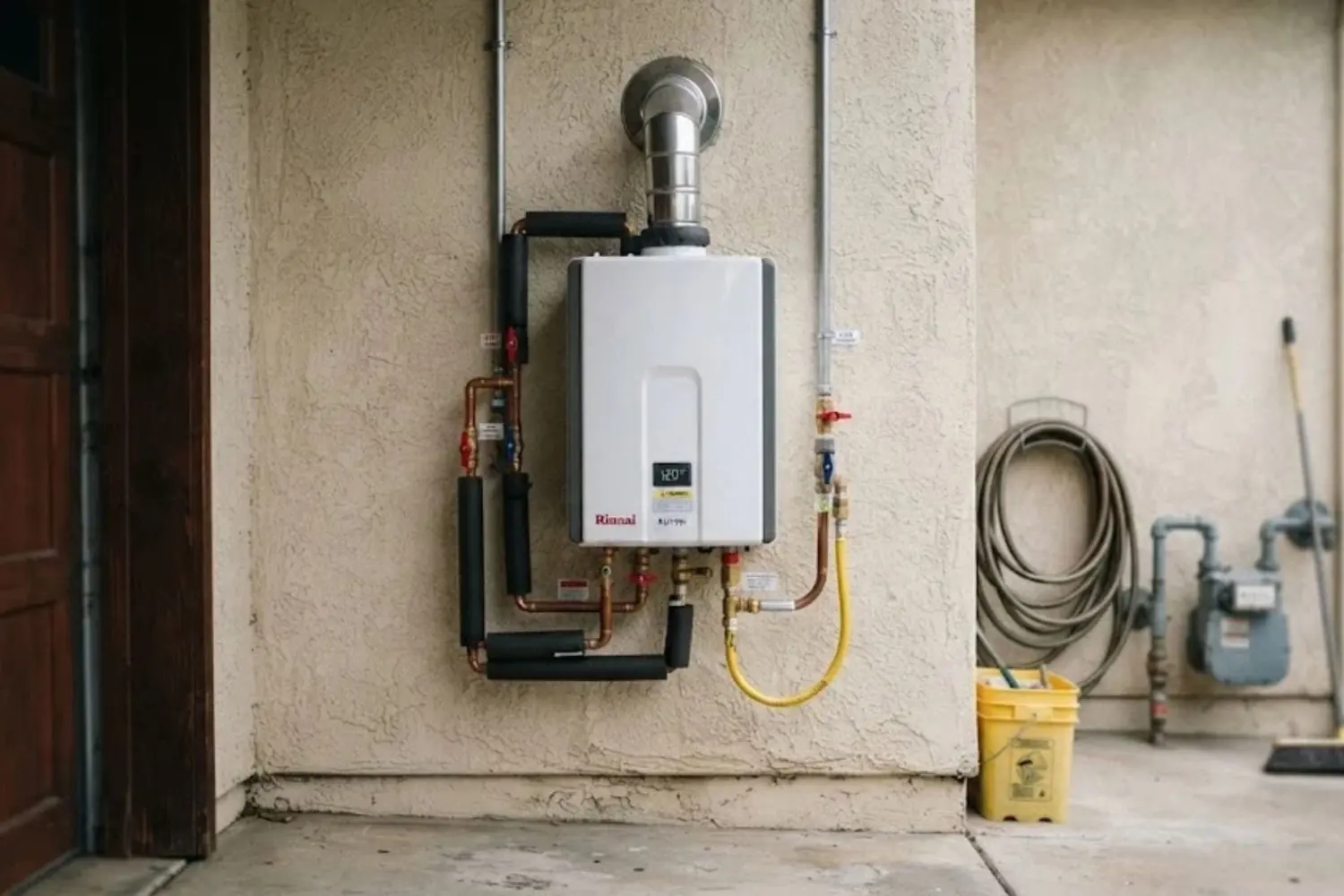
Why homeowners consider an outdoor unit
- It frees up floor space in a small basement or utility room.
- Venting is simpler because exhaust goes outdoors directly.
- The unit can sit close to a gas meter or an exterior wall near the kitchen or bath.
- Replacing a tank in a tight rowhouse basement may leave no better option.
Outdoor heaters are built differently from indoor ones. They have a weather-resistant housing and built-in freeze protection. Do not install an indoor model outside, even under a roof.
Freeze protection is the main question
Outdoor models use small electric heaters to keep internal parts from freezing, but those only work if the unit has power. A power outage during a deep freeze can leave the heater and the pipes exposed. Cold-climate homeowners also protect the exposed water lines with insulation and heat tape.
| Winter risk | What helps | What to ask the installer |
|---|---|---|
| Power outage during a freeze | Drain-down procedure, backup power | How do I drain it if the power fails? |
| Exposed supply and return lines | Insulation, heat trace | How will the lines be protected? |
| Wind and snow | Sheltered location, clearance | Is the unit placed in a protected spot? |
| Condensate line freezing | Heated or short line, proper slope | Where does the condensate drain? |
In a climate that sees hard freezes, many installers would still put the unit inside when there is a place for it. Outdoor makes sense when indoor space is the real problem. Ask for a clear explanation of the winter plan before you sign off.
Gas, power and clearances
A gas unit needs a gas line sized for its input. Tankless heaters demand a lot of gas when they fire, and a line that fed a tank may be too small. Outdoor units also need electric power, a water supply and a place to drain condensate. Clearances to windows, doors and the meter are set by the manufacturer and by code.
Gas work always puts safety first. If you ever smell gas, leave the house and call the gas utility or 911 before you call us. Our water heater installation page covers how we plan an install, and the tankless water heater page covers service.
What maintenance looks like outdoors
An outdoor heater is exposed to weather, leaves and insects. Check that the vent opening and intake stay clear, especially after storms and in autumn. Keep snow and ice away from the unit, and keep a path to it that you can reach in winter.
The annual service is the same as for an indoor unit: flushing scale from the heat exchanger and checking the filters and connections. Because it sits outside, you will want to schedule it in milder weather and know where the isolation valves are before a freeze.
Before a hard freeze, check the power supply, confirm the freeze protection is on and look at the insulation on the exposed pipes. If the forecast calls for an extended outage, ask your installer how to drain the unit. Having that plan written down is worth more than any feature on the spec sheet.
Remember that the unit is only part of the project. A tankless heater in a rowhouse or twin usually replaces a tank, so the old tank has to come out, the new gas and water connections have to be made and the exhaust has to terminate where the code allows. Ask how disposal of the old tank is handled and whether the price includes it.
Planning a Tankless Install?
Tell us where the heater sits now and what space you have. Our 24/7 line is open now.
Permits and licensing in Upper Darby
Upper Darby Township has adopted the Pennsylvania Uniform Construction Code and requires permits for some residential alterations and repairs. Replacing a water heater with a gas appliance in a new location is the kind of work to check with the Department of Licenses and Inspection.
Upper Darby Township Code Chapter 265 says plumbing contractors working in the township must employ a licensed master plumber, and only the master plumber can apply for plumbing permits. Plumbing licenses in the township expire on March 31 each year.
Pennsylvania also requires contractors who do at least $5,000 a year in home improvement work to register with the Attorney General. You can look a contractor up at hicsearch.attorneygeneral.gov. Registration is not an endorsement, but it is a fair first check.
Comparing indoor and outdoor
| Indoor tankless | Outdoor tankless | |
|---|---|---|
| Freeze exposure | Low | Higher, needs protection |
| Venting | Needs a vent run | Direct to the air |
| Space used inside | Wall space | None |
| Service access | Inside the house | Outside in all weather |
Questions to ask before you buy
- Is the unit rated for outdoor use, and what are its freeze limits?
- What size gas line and meter does it need?
- Where will it sit, and how far from windows and doors?
- What happens in a power outage?
- What permits does the work need?
We serve Darby and Clifton Heights near Upper Darby, and you can read about them on our Darby plumber and Clifton Heights plumber pages.
Sources: outdoor ratings, clearances and freeze limits come from the manufacturer's installation standards, and gas piping and venting fall under the International Plumbing Code (IPC) and the township.
Questions Upper Darby homeowners ask
Yes, especially during a power outage. Outdoor models have freeze protection, but it depends on power, so ask about a drain-down plan.
Many water heater installs do. Ask the Department of Licenses and Inspection, and we will tell you what our installs involve.
It depends on your space. Outdoor frees up room and simplifies venting, but it faces winter exposure. Indoors is easier to protect when there is room.