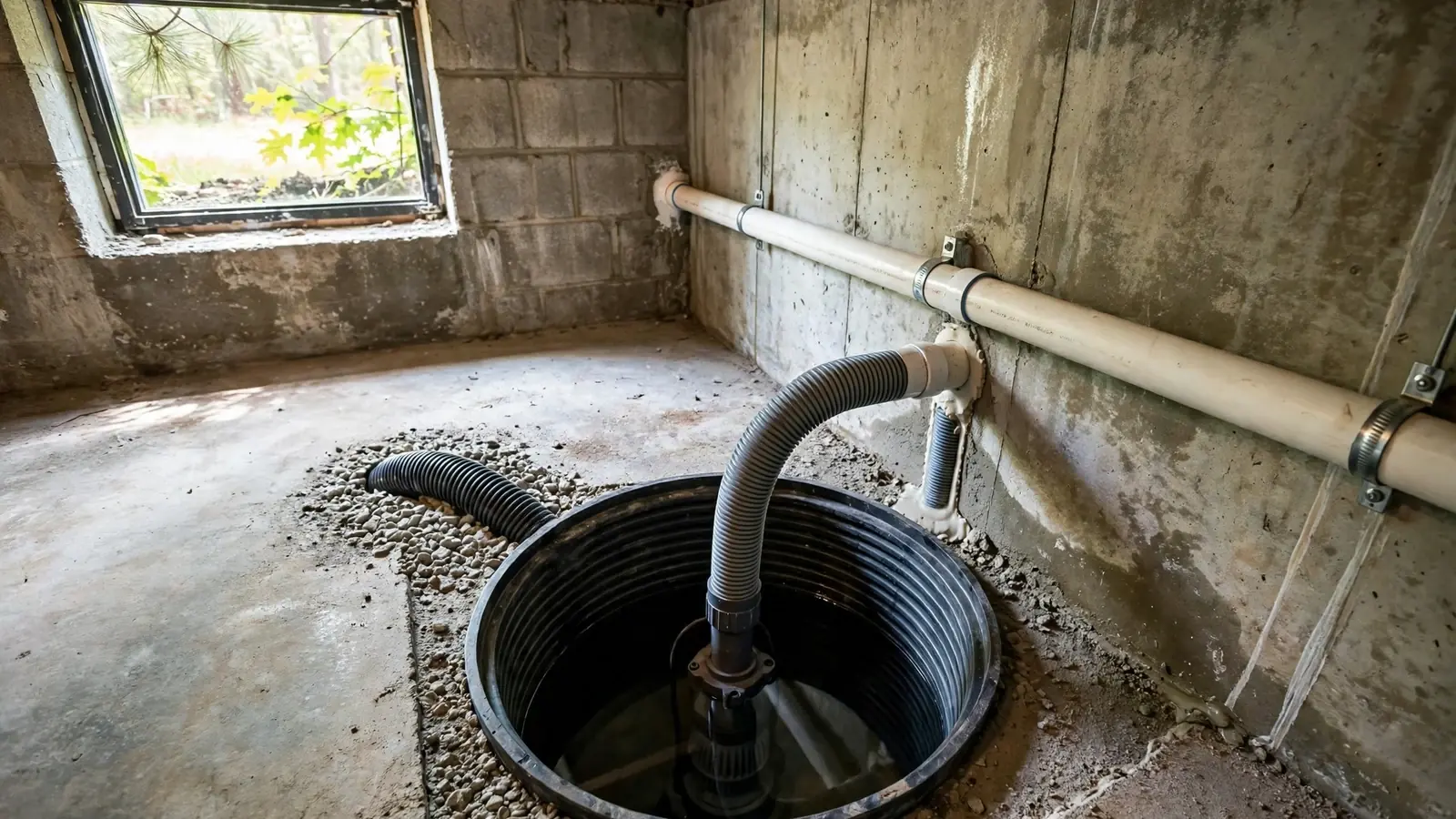
How the discharge line works
The pump pushes water up through a pipe with a check valve, through the basement wall and away from the foundation. The check valve keeps water from flowing back down into the pit. The pipe outside ends at a spot where water can flow away without returning to the house.
If any part fails, the pump may cycle too often, make noise or run without lowering the pit.
Common discharge line problems
| Problem | Sign | Fix |
|---|---|---|
| Frozen outlet | Pump runs, water backs up in the pipe | Thaw, clear, add a freeze-resistant outlet |
| Crack or loose joint | Wet spot at the wall or yard, water sprays inside | Replace the pipe or joint |
| Clogged or crushed pipe | Pump strains, slow discharge | Clear the line or replace the section |
| Failed check valve | Pump cycles often, water falls back | Replace the valve |
| Discharge too close to the house | Water returns to the foundation | Extend the pipe |
To test, pour water into the pit and watch the outlet. If water arrives quickly and flows away from the house, the line is working. If it trickles or stops, there is a restriction or a break.
Where the water should go
Discharge water should flow away from the house to a place where it cannot flow back. It should not be sent into the sanitary sewer, because stormwater overloads the system. Local rules apply to where it can go, and a neighbor's property is not an option. We explain the options for your lot before we pipe anything.
If you have no pump yet, or yours is old, see sump pump installation and repair, and for wider moisture problems see basement waterproofing.
Winter and the discharge line
In winter, an outlet at ground level can freeze closed or fill with ice, and the pump will push water against a plug. Water that cannot leave the pipe may leak at the joints or force the pump to work too hard. A freeze-resistant outlet or a pipe that slopes to drain when the pump stops lowers the risk.
- Keep the outlet clear of leaves, snow and ice.
- Make sure the pipe slopes away from the house, with no low spots that hold water.
- Insulate exposed pipe where it makes sense.
- Check the outlet after a cold snap.
Signs the discharge line needs attention now
- A wet or muddy patch in the yard along the pipe route.
- Water spraying or dripping at a joint near the wall.
- A pump that cycles every few seconds even in dry weather.
- A gurgling sound as water falls back through the pipe.
Any of these can show up in the middle of a storm, which is the worst time to find out. Walk the line on a dry day and look for sections that sag, crack or sit under soil that has washed away.
If you have to replace the line, rigid PVC with solid glued joints is common for the indoor part, with a short flexible section where it passes outside if the manufacturer allows it. Keep the number of elbows small, because each one adds resistance and gives debris a place to catch.
Pump Running Nonstop?
Check the outlet outside for ice or a break, and call if the pit is rising. Our 24/7 line is open now.
Water, creeks and local rules around Upper Darby
Cobbs Creek runs along Upper Darby Township's eastern border, and Darby Creek runs through the surrounding area. Heavy storms can raise groundwater, but we do not say that any particular street floods. Ask the township about rules for discharging pump water near streets, sidewalks and storm drains.
Upper Darby Township has adopted the Pennsylvania Uniform Construction Code and requires permits for residential alterations and repairs. Permit rules vary by job, so ask the township Department of Licenses and Inspection what applies to yours.
Upper Darby Township Code Chapter 265 says plumbing contractors working in the township must employ a licensed master plumber, and only the master plumber can apply for plumbing permits. Plumbing licenses in the township expire on March 31 each year.
Repair steps
- Turn off power to the pump and unplug it.
- Check the check valve and the pipe above it for cracks and clogs.
- Trace the pipe outside to find the leak, the freeze or the low spot.
- Replace damaged sections with the right pipe and fittings, glued or sealed as required.
- Restore power, fill the pit and watch the pump and the outlet.
We serve Yeadon and Clifton Heights close to Upper Darby, and you can read about them on our Yeadon plumber and Clifton Heights plumber pages.
Before the next storm
Test the pump and the discharge line on a dry day. A pump that works but has nowhere to send water is no help. If the discharge line is old, buried or cracked, replace it before it fails, not after the basement floods.
Sources: the pump maker's guidelines set discharge size and check valve use, and the International Plumbing Code (IPC) limits where stormwater may be sent.
Questions Upper Darby homeowners ask
The discharge line may be frozen, clogged or broken, or the check valve may have failed. A plumber can test each part.
It should not. Stormwater and groundwater should not go into the sanitary sewer. Ask Upper Darby Township about the rules for your property.
Far enough that the water does not flow back to the foundation. The right distance depends on the slope of your lot.