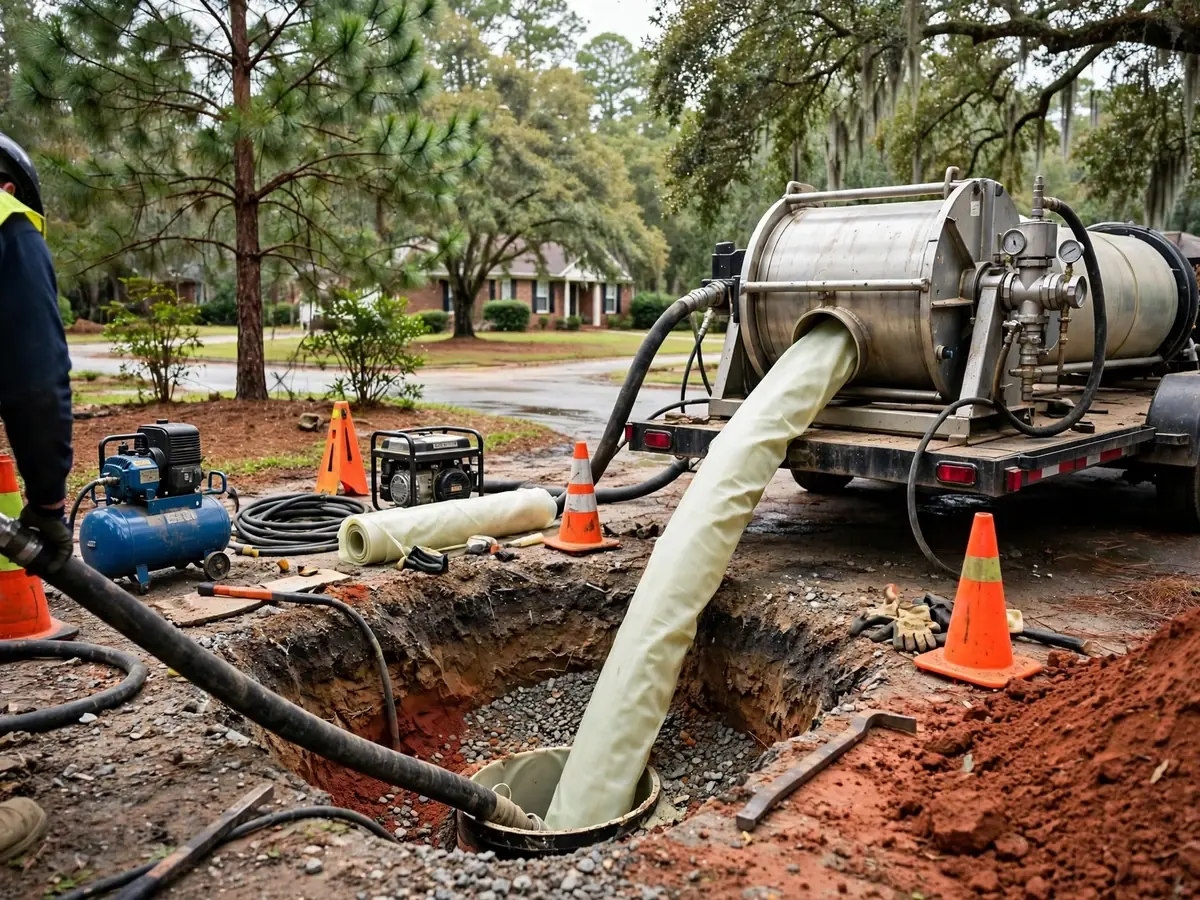
What pipe lining is
A flexible tube soaked in resin is pulled into the damaged pipe through an access point, then inflated and cured so it hardens against the pipe wall. When it cures, it forms a smooth, tight pipe inside the old one. The industry name is cured-in-place pipe, and a pull-in-place method uses a liner pulled through from one access point to another.
A lined pipe has a slightly smaller inside diameter, but a smooth surface that resists roots and buildup. It can seal cracks, joints and small holes without removing the whole pipe.
When lining fits and when it does not
| Condition | Lining a good fit? | Why |
|---|---|---|
| Cracks and open joints | Yes | The liner seals them |
| Root intrusion at joints | Yes, after cutting the roots | The liner blocks new roots |
| Pipe collapsed or crushed | No | The liner cannot pass |
| Pipe with a belly holding water | No | Lining follows the pipe, so the low spot stays |
| Pipe with severe offset joints | Sometimes | Depends on the offset |
A camera inspection decides this. Our sewer inspection page explains what the video shows, and the sewer line repair page explains the repair options in full, including digging and replacing.
The steps
- 1
Inspect
A camera shows the pipe condition, the length and where the access points are.
- 2
Clean
The pipe is cleared of roots and debris by cutting or hydro jetting.
- 3
Line
The resin-soaked liner is pulled in, inflated and cured.
- 4
Verify
A second camera run confirms the liner is tight and the connections are open.
Cleaning matters as much as the liner. If roots or scale are left behind, the liner will not bond well. Access points are usually a cleanout, a basement opening or a small pit dug in the yard.
Benefits and limits
- Less digging means less damage to lawns, patios and driveways.
- The repair is often faster than a full replacement.
- The new surface is smooth and root resistant.
- The job needs a pipe that is not collapsed, and connections must be handled with care.
- Lateral connections, such as a branch joining the main, have to be reopened after lining.
Lining is a repair, not a replacement of the structure around the pipe. If soil is washing into the pipe or the pipe has failed over a long length, replacement may serve better. A reputable contractor should tell you which one fits your pipe, not just the one they sell.
How lining compares with digging
Traditional repair opens a trench, removes the damaged pipe and installs a new one. It gives you a brand-new pipe, but it disturbs whatever is above it, such as a driveway, a porch or a mature tree. Lining leaves most of that in place and uses small access openings.
Digging still wins in some cases. A collapsed pipe, a long section that has sagged or a pipe with failing connections along its length may need to be replaced. A good contractor will explain why a method fits your pipe, show the video that supports the choice and give you a written scope for each option so you can compare them honestly.
Sewer Backing Up?
Stop using water and call. We will camera the line. Our 24/7 line is open now.
Permits, utilities and the sewer connection in Upper Darby
Upper Darby Township has adopted the Pennsylvania Uniform Construction Code and requires permits for residential alterations and repairs. Permit rules vary by job, so ask the township Department of Licenses and Inspection what applies to yours.
Upper Darby Township Code Chapter 265 says plumbing contractors working in the township must employ a licensed master plumber, and only the master plumber can apply for plumbing permits. Plumbing licenses in the township expire on March 31 each year.
Before any excavation, Pennsylvania law requires a call to the state one-call system, which you reach by dialing 811. It has underground utilities marked so a crew does not strike a gas, electric or water line. Ask the township which parts of the sewer lateral belong to you and which to the township or the sewer authority.
Older rowhouses and shared laterals
Homes in the older boroughs near Upper Darby often have laterals that are decades old. In attached houses, a lateral can run close to a neighbor or share a run, and that changes the planning. We ask the age of the house and look at what the camera shows before recommending anything.
We serve Clifton Heights and Lansdowne close to Upper Darby, and you can read about them on our Clifton Heights plumber and Lansdowne plumber pages.
What to ask a contractor
- Did you camera the pipe, and can I see the video?
- Is my pipe a good candidate, and why?
- How will connections and cleanouts be handled?
- What is the warranty on the liner?
- What permits does the work need?
Sources: trenchless lining materials are tested to published ASTM standards, and the International Plumbing Code (IPC) covers building drain and sewer work.
Questions Upper Darby homeowners ask
Manufacturers and contractors quote long service lives, but real life depends on the pipe, the installation and the soil. Ask for the warranty in writing.
No. A collapsed pipe has to be repaired by excavation or another method, because the liner cannot be pulled through.
Likely yes for some part of it. Ask the Department of Licenses and Inspection, and remember that only the licensed master plumber can apply for plumbing permits.