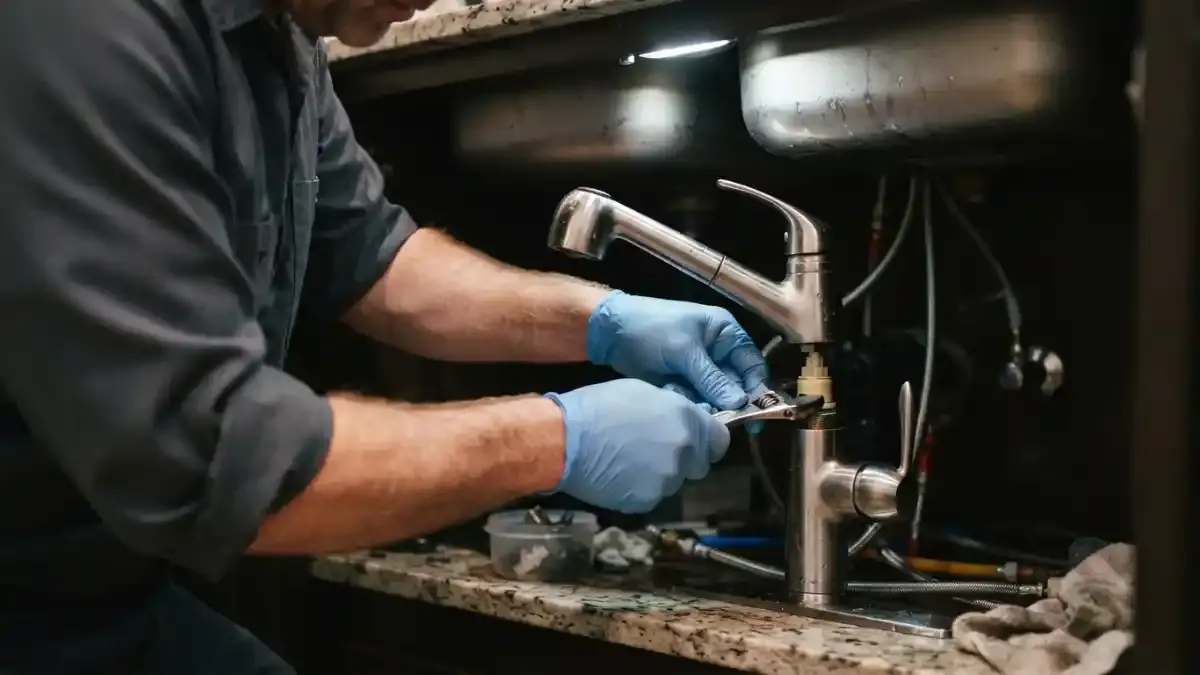
Why a faucet drips
A faucet is a valve. Inside it, a rubber washer, an O-ring or a cartridge stops the flow when the handle closes. Those parts wear out from use and from minerals in the water. When the seal no longer closes fully, water slips past and drips from the spout.
A drip of one drop per second adds up to thousands of gallons a year, which shows up on your water bill. A faucet that leaks at the base or the handle is a different problem and usually points to a worn O-ring or a loose packing nut.
Find out which type of faucet you have
| Type | How to spot it | Usual cause of a leak |
|---|---|---|
| Compression | Two handles that you turn several times | Worn rubber washer or damaged seat |
| Cartridge | One or two handles with smooth movement | Worn cartridge or O-rings |
| Ball | Single handle over a rounded cap | Worn seals and springs |
| Ceramic disc | Single handle with a wide cylindrical body | Cracked disc or worn seals |
Each type uses different parts, so identify yours before you buy anything. Take a photo of the faucet and the part you remove, and bring both to the hardware store. Many repair kits are sold by brand and model, so the brand name on the handle or spout helps.
Basic repair steps for most faucets
- Close the shutoff valves under the sink by turning them clockwise. If there are none, close the main water valve.
- Plug the drain so small parts cannot fall in, then open the faucet to release pressure.
- Remove the handle, usually by prying off a cap and removing a screw.
- Pull out the cartridge or remove the stem and inspect the washer, seat and O-rings.
- Replace worn parts with exact matches, reassemble and turn the water back on slowly.
If water still leaks or the handle now sticks, stop and call. Forcing a seized stem can crack the valve body, and a repair that would have cost a small part becomes a new faucet.
Repair or replace
Repair makes sense when the faucet is fairly new, parts are available and the finish is sound. Replacement is better when the faucet is corroded, parts have been discontinued or you have already repaired it more than once. Our faucet repair page explains what we check before we recommend either one.
Kitchen faucets with pull-down sprayers add hoses and couplers to the list of parts that can leak under the sink. A puddle in the cabinet may be coming from a hose or a supply line and not the faucet at all.
When a leak is not a faucet problem
- Water under the sink even when the faucet is off may come from the drain trap or a supply line.
- A tub spout that runs when the shower is on usually needs a new diverter.
- A wet cabinet floor or ceiling below the bathroom can mean a leak inside the wall.
- A shutoff valve that will not close needs to be replaced before any other repair.
For hidden leaks, plumbing installation work often includes replacing the old shutoffs and supply lines so the next repair is easy. If water is already spreading, close the main valve and call us.
Prevent the next drip
Faucets wear faster when water is hard and when handles are forced shut. Close handles gently and stop turning when the flow stops. Every year or so, wipe mineral deposits from aerators and spouts, and check under the sink for dampness. A dry cabinet floor is a good sign, and a dark or swollen one is an early warning.
If your house has several old faucets leaking in different rooms, the cause may be pressure or water chemistry rather than bad luck. A plumber can check your pressure with a gauge at an outdoor spigot. Pressure that runs too high wears out washers and cartridges faster, and a regulator can bring it down.
Tools worth having
- An adjustable wrench and a set of hex keys for handle screws.
- Plumber's grease for O-rings and a small pick to remove them.
- A flashlight and an old towel for the cabinet floor.
- A photo of the faucet brand and model before you shop for parts.
Faucet Leaking?
Close the shutoff valve under the sink and call if it will not stop. Our 24/7 line is open now.
What Upper Darby homeowners should know before hiring
Upper Darby Township Code Chapter 265 says plumbing contractors working in the township must employ a licensed master plumber, and only the master plumber can apply for plumbing permits. Plumbing licenses in the township expire on March 31 each year.
Pennsylvania also requires contractors who do at least $5,000 a year in home improvement work to register with the Attorney General. You can look a contractor up at hicsearch.attorneygeneral.gov. Registration is not an endorsement, but it is a fair first check.
What a plumber will check
A plumber starts by watching the leak and asking when it began. Then they identify the faucet, shut off the water and open the faucet to inspect the wear. We tell you what we find, give you a price before we start and explain whether a repair or replacement makes sense.
If you live near Lansdowne or Yeadon, our plumbers cover both, and you can read about them on our Lansdowne plumber and Yeadon plumber pages.
| Situation | Do it yourself? | Call a plumber? |
|---|---|---|
| Drip from the spout, new faucet | Often yes | If parts do not fit |
| Seized or corroded stem | Risky | Yes |
| Shutoff valve will not close | No | Yes |
| Leak inside the wall | No | Yes, right away |
Sources: parts and steps follow your faucet manufacturer's guidelines, and plumbing work for hire is judged against the International Plumbing Code (IPC) used under the Pennsylvania Uniform Construction Code.
Questions Upper Darby homeowners ask
A simple cartridge or washer swap can take under an hour. A seized stem or a hidden shutoff problem can take longer, and a plumber will tell you before starting.
Usually no. A faucet that will not shut off or a supply line that sprays is. Close the shutoff valve and call.
Homeowners can repair their own fixtures. A plumbing contractor working for hire in the township must employ a licensed master plumber under township code.